

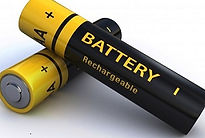


Forms of potential energy. From left to right: elastic, chemical, electriacl and thermal
Conservation of Energy
10 Misconceptions about Energy
1. Energy is a thing.
Energy is an abstract concept of an indirectly observed quantity. It refers to a condition or state of an object, and is not an object itself. Energy of an object is equivalent to how much work the object or system can do on some other object or system.
2. Energy is used or lost in many energy transformations.
In all energy transformations, the total energy remains the same. A transfer of energy may occur between systems which results in a loss to compensate any gain. This principal is the subject of the Law of Conservation of Energy.

3. Energy can be changed completely from one form to another.
The transfer of energy between systems is not completely efficient. While the total amount of energy in the system remains constant, some energy will be wasted and transferred to a non-useful form.
4. An object at rest has no energy.
An object at rest has potential energy that is stored within the system and can be converted into other forms of energy.
5. The only type of potential energy is gravitational energy.
There are many other types of potential energy, in addition to gravitational energy. These include elastic, chemical, electrical and thermal potential energies.
6. Energy is stored in food and fuel.
Energy can not be stored though energy can be obtained from the combustion of food and fuel.
7. Gravitational potential energy depends only on the height of an object
While gravitational potential energy is dependent on the height of the object from a zero position, it is also dependent on the mass of the object and the acceleration caused by gravity.
8. We are running out of energy, it must not be conserved.
The total amount of energy in the universe never changes. Rather energy can be converted into low grade heat energy which in turn cannot be turned into useful work.
9. Energy and Force are interchangeable terms.
Energy and force are not the same. Energy is an abstract term used to describe the state or condition of an object whereas a force is an easily demonstrated action that is applied to an object. When considering the units, Force is measured in Newton’s and Energy is measured in Joules.
10. The kinetic energy of an object will double when the speed of the object doubles.
The kinetic energy of an object is proportional to the square of the factor by which the speed changes, as defined by the equation for kinetic energy (KE) with known mass (m) and velocity (v): KE = 0.5 ∙ m ∙ v2


